How California divides fault after a car accident
Li v. Yellow Cab Co. explains California’s move from an all-or-nothing negligence rule to comparative fault. The evidence, not a universal crash chart, supports the share of fault. Separate rules can apply when several defendants are responsible or different kinds of damages are involved.
Sources: Li v. Yellow Cab Co. (1975) 13 Cal.3d 804 ↗ · Civil Code section 1714 ↗
A hypothetical percentage-of-fault example
For a made-up example with one defendant, suppose damages are $100,000 and the injured person has 20% of the fault. A 20% reduction leaves $80,000 before other limits or deductions. This illustrates arithmetic, not a case estimate or a promise of collection.
Sources: Li v. Yellow Cab Co. (1975) 13 Cal.3d 804 ↗ · Civil Code section 1714 ↗
SEE THE DISTINCTIONS
Comparative fault: a hypothetical reduction
- 01
$100,000 in damages
Assume this is the proved harm in a simple case with one defendant.
- 02
20% assigned to you
For this made-up example, reduce the damages by $20,000.
- 03
$80,000 after the reduction
Other legal limits, fees, insurance and collection issues remain separate.
Hypothetical numbers to explain a rule, not the value of a real claim.
Sources: Li v. Yellow Cab Co. (1975) 13 Cal.3d 804 ↗
Download this diagram ↗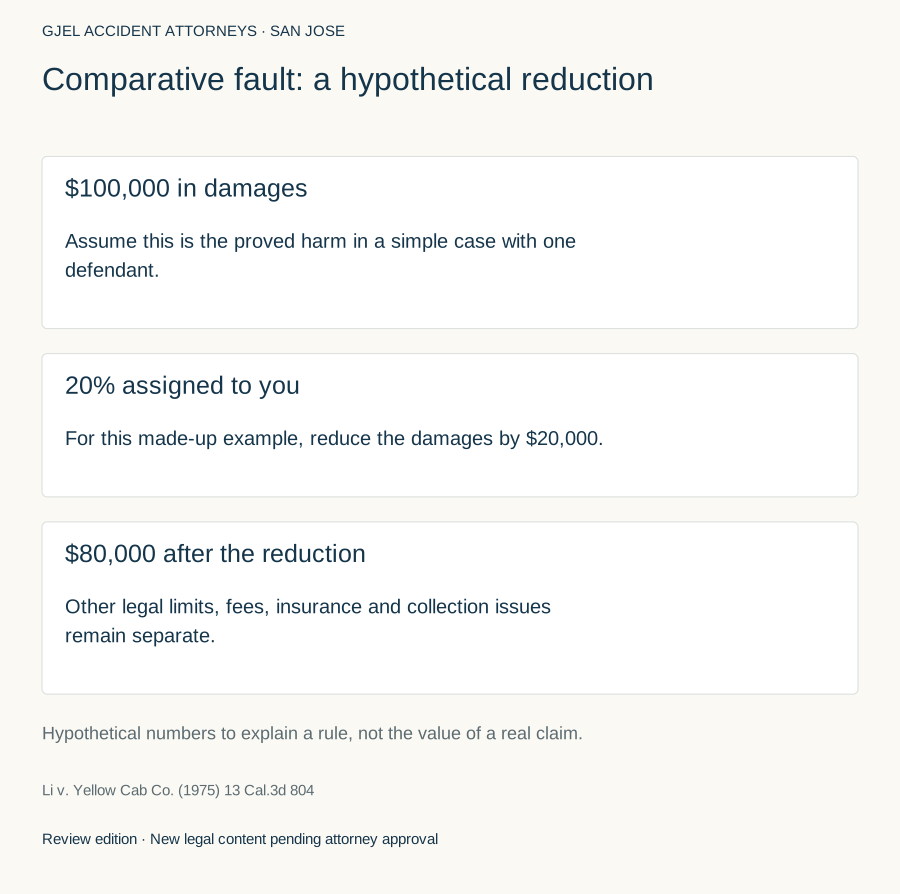
Why a traffic violation does not answer every question
For a useful review, keep the following information together. You do not need to enter it on this website.
- The actual policy, bill, report, or notice involved.
- Dates and facts that could change which rule applies.
- The questions you want an attorney to answer before you take a step.
READ THE DECISIONS
Court decisions relevant to california comparative fault after a car accident
Li v. Yellow Cab Co.
(1975) 13 Cal.3d 804, pp. 827–829
A person can share fault and still have a negligence claim. Their share of blame can reduce the recovery.
Limits of this decision: This does not set anyone’s fault percentage. Other limits and defenses can still matter.
Read the opinion ↗DaFonte v. Up-Right, Inc.
(1992) 2 Cal.4th 593, pp. 600–604
Each defendant’s share of noneconomic harm was tied to its share of fault. That type of harm includes pain.
Limits of this decision: Financial losses follow different rules. The case also involved an employer that could not be sued for the same harm.
Read the opinion ↗Review information for this guide is recorded above. Read each decision with its stated limits.
Legal and agency sources for this page
Use the sources to read the underlying rule or current official process. A source link is not personal legal advice.
- Li v. Yellow Cab Co. (1975) 13 Cal.3d 804 ↗
- Civil Code section 1714 ↗
- DaFonte v. Up-Right, Inc. (1992) 2 Cal.4th 593 ↗
Reviewed by Andrew Ronald Gillin · 2026-11-05 · Review and correction process